Six years apart, then a flight from Seoul
Doges Editorial · 2026-06-02 · 5 min read
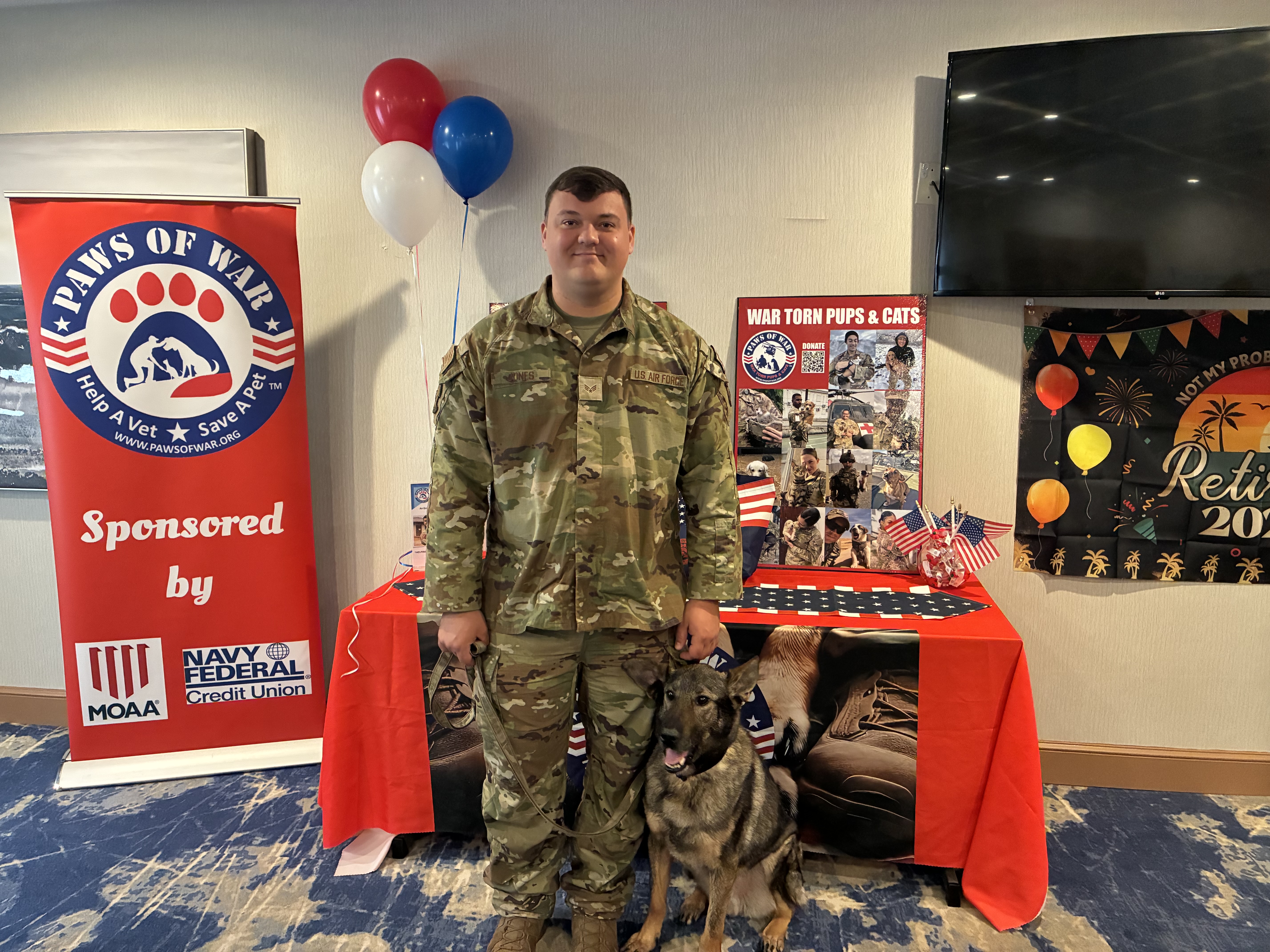
Senior Airman Alex Jones met German Shepherd Max in a South Korean military kennel in 2020, spent years asking friends to pass along check-ins, and then Paws of War flew to Osan, picked up the retired military working dog, and drove him from JFK to North Carolina.
Every time Alex Jones heard that someone he knew was deploying to Osan Air Base in South Korea, he made the same request. Hey — could you check on Max for me? Eight-year-old German shepherd, patrol dog, black-sable coat. You'll find him in the base kennel. Let me know how he's doing.
That was the whole arrangement. No formal claim on the dog, no paperwork, no plan. Just a request passed from friend to friend across six years and a Pacific Ocean, a small thread of attention stretched between a man in North Carolina and a working dog still on duty in South Korea. As the Jacksonville Daily News reported from the reunion ceremony in Sneads Ferry on May 22, 2026, this is how the story started: in a base kennel, during routine in-processing, in 2020.
How it started in a base kennel
Senior Airman Alex Jones joined the Air Force in 2017. When he arrived at Osan during his deployment, he did what personnel do: checked in, completed paperwork, visited the facilities. One of those facilities was the kennel. Max was there. Max had been there for years — a patrol-only military working dog with multiple handlers over the course of his career, assigned to protect the base. Jones wasn't officially his handler. They weren't a team in the technical sense. They were, instead, the other thing: a person and a dog who found each other in a hallway and decided the other was worth paying attention to.
Military working dogs carry a particular presence — alert, contained, a kind of coiled readiness that civilian dogs don't have. You can see it in how they hold themselves, how they take stock of a room. Max, apparently, was also good company. The bond that formed between him and Jones during those months at Osan didn't follow any official line of command. It formed the way bonds form: proximity, consistency, and a dog that decided a specific human was worth orienting toward.
The bond that outlasts the assignment
When Jones rotated home to the United States, Max stayed at Osan. That's how it goes. The dog is mission equipment in the language of military operations, and mission equipment doesn't follow personnel. Jones transitioned to the reserves in 2024 after nearly seven years of active service. Max kept working. Neither of them had any reason to expect to see the other again.
If I knew a friend was going over there, I'm like, hey, check on Max for me, and they would be like, yeah, he's still doing good.
— Alex Jones
Six years of checking in
There's something quiet and specific about what Jones did for six years — not grand, not dramatic, just persistent. A request, a relay, a confirmation. The friend deployed, looked in on Max, came back, reported. Max was fine. Still at Osan. Still working. The check-ins were small, but they were also a form of loyalty: staying in relationship with a dog who couldn't know anyone was still thinking about him.
Paws of War, a 501c3 nonprofit based in the Northeast, runs several programs for military families and veterans — helping members care for their own pets while deployed, training and placing service dogs for veterans and first responders. One of its more specific missions is reuniting retired military working dogs with the service members they bonded with. Niki Dawson, director of animal welfare and logistics for the organization, has made those international trips many times. She knew what it meant to Jones when the organization identified Max as eligible for reunification.
A flight from Seoul
When the reunion was arranged, Dawson flew to South Korea herself. She normally plans for several days on base, acclimating to a new dog before attempting to transport him internationally. Military working dogs are trained for intensity and may be difficult to handle in unfamiliar situations. Max, it turned out, had skipped that part.
As soon as I met Max, I was like, oh gosh, this is like being around my own dog. He was so incredibly social and friendly and happy and just made the process so easy.
— Niki Dawson, Director of Animal Welfare and Logistics, Paws of War
Dawson flew back with Max from JFK, then drove south to Sneads Ferry, North Carolina, for the ceremony Paws of War had organized. On May 22, 2026, Max received a Hero with a Heart award recognizing his six years of service at Osan. Then he was handed, leash and all, to Jones. Jones, who had been sending check-ins for six years. Max, who had no idea any of that had been happening — and who apparently didn't need to know.
What haunts a service member
When the service members rotate out and they're back home in the United States, that thought of the dog that they love and they bonded with never leaves them. It's something that sometimes haunts them. I've had conversations with service members that they weren't able to get their dog back and years later they still think about that particular dog.
— Niki Dawson, Paws of War
Dawson has seen this enough times to know it isn't softness or sentimentality. It's something about the quality of the presence a working dog brings to a deployment: completely available, impossible to fool, carrying no agenda beyond the immediate moment. The dog doesn't know about the mission or the career or the years before. It knows who's on the other end of the leash. That specificity, that radical attentiveness — it leaves a mark. People carry it home even when they can't carry the dog.
Jones said Max has done a complete 180 since leaving military service. The patrol dog alertness is still there in the architecture of how he moves, but it runs underneath something calmer now. Goofy, Jones said. Max is goofy. It's a word that doesn't usually follow German Shepherd Military Working Dog, and maybe that's the point — the word is Max's now, not the role's.
The walk they get to take now
Max spent six years at Osan doing the same patrol loops, the same watch rotations, the same work that military working dogs do. He was excellent at it. Now the days have a different shape: no kennel schedule, no shift rotation, no mission brief. Just Jones, and North Carolina, and whatever routes they decide to take together in the morning. Dogs who've worked that hard tend to be very good at rest when it finally comes. They know the difference between a shift and a life — and Max, by all accounts, is learning the second one fast.