He rescued her in a blizzard and called her Sadie. Twelve years later, she called him back
Doges Editorial · 2026-06-01 · 6 min read

In January 2014, Aaron Foster coaxed a frightened dog out of a Colorado snowstorm, loved her, and found her a home he thought would be forever. On January 7, 2026 — exactly twelve years to the day — a shelter 450 miles away called to say they had his dog.
On the morning of January 7, 2014, Aaron Foster spotted a dog running through a blizzard in Boulder, Colorado. She was a young German Shorthaired Pointer — brown and white, alone, moving the way frightened dogs move: no destination, just the instinct to keep going. It took him twenty minutes to coax her close enough to help. When he finally got her inside, she pressed herself into a corner and watched him from across the room, still not convinced that warmth was something she was allowed to have.
He named her Sadie. He had no idea what he was setting in motion.
A dog he couldn't keep, and everything he did anyway
Foster, 53, was living in Boulder at the time and knew from the start that his situation couldn't be permanent for Sadie. He was about to spend a year traveling — the kind of travel that doesn't fit a dog into the schedule.
I had her spayed and chipped, and really fell in love with her, but I still had to find her a good home before I left.
— Aaron Foster
He did everything right. He had Sadie spayed. He had her microchipped and put his own contact information on the chip. He drove her to a rescue center in Arizona, found her an adoptive family, and believed, as much as you can believe these things, that the story had found a good ending.
A lot can happen in 12 years, but I felt like I let her down by not finding her a true forever home. So I knew I couldn't keep her long term, but I wanted to be sure she found the best home.
— Aaron Foster
Sadie was adopted in 2014. Foster moved on. In 2019, he adopted a dog of his own — a dog named Bodie — and built a life in Reno, Nevada. He thought about Sadie sometimes, the way you think about the ones you had to let go.
The energy of a dog who never wore out
German Shorthaired Pointers are not dogs who pace themselves. They are athletic, relentless, built for long days in the field — for tracking, pointing, and retrieving across whatever terrain appears between them and the thing they want to find. When Foster first brought Sadie in from the snowstorm, she was terrified and cold. She was also, underneath all of that, made of extraordinary velocity.
"She had so much energy, it was almost impossible to wear her out," he told Newsweek in January. "But she was also VERY sweet and a bit needy in the beginning." The cold and the fear had kept her wary; warmth had made her enormous. By the time he drove her to Arizona, she had stopped being the dog in the corner and started being, in every room she entered, the thing around which everything else briefly organized itself.
He thought about that energy sometimes, in the years after. Whether the family he'd found had known what to do with it.
Exactly twelve years later, to the day
On January 7, 2026 — twelve years to the day after he had found Sadie in the blizzard — Aaron Foster received a phone call from The Animal Foundation, a shelter in Las Vegas, Nevada. They had found a dog. No collar, no tags. But there was a microchip. And the microchip, still intact and still transmitting after more than a decade, still carried his name and his number.
The Animal Foundation is 450 miles from Reno, where Foster lives now. The distance was not a consideration.
I'm on my way, sweet girl.
— Aaron Foster
What the microchip carried across twelve years
A microchip is a small thing — a radio-frequency identification device about the size of a grain of rice, implanted under the skin between a dog's shoulder blades. It costs less than a dinner out. It is not a GPS tracker. It doesn't broadcast a signal. It simply holds a number that links, in a database, to a name and a phone number. It waits, passively, for a scanner to find it.
Sadie had carried Foster's number through one adoption, through whatever travels or reversals brought her to Las Vegas without a collar, through more than four thousand days. The number still worked. The shelter scanned her, found his information, and made the call that made his day.
The story became public through The Animal Foundation's announcement, picked up by People, Newsweek, and ultimately featured in the May/June 2026 issue of Best Friends magazine, which called it a "full-circle connection." That framing understates how singular the timing was. January 7, 2026. Twelve years, to the exact day. If you believe in meaningful coincidences, this one earns the category.
She's home
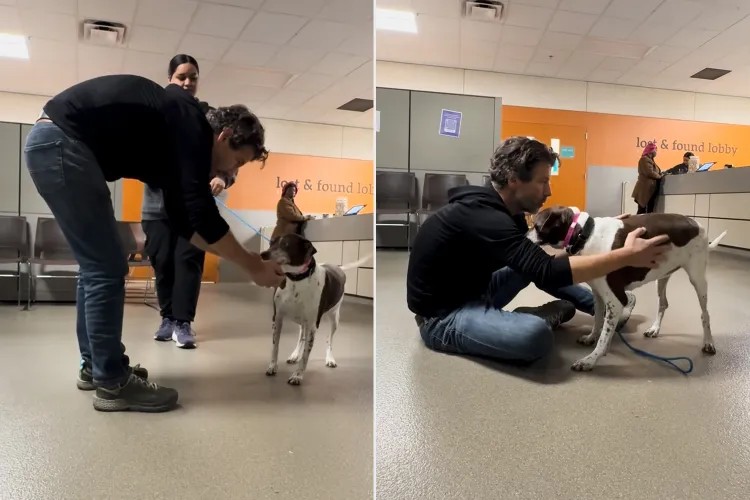
Foster booked a flight and went to get her. Sadie, now in her early teens by the estimate of the shelter's vets, had slowed down from the dog who had once been impossible to tire. But she recognized something. The transition from the shelter into Foster's care was, by all accounts, quiet and immediate.
Back in Reno, Sadie met Bodie. The two bonded. Best Friends reported that Foster now "wants to make her golden years the best years of her life." He said it more simply: "She's home. And this time, it's for good."
What it means to put your name on someone
The practical lesson here is obvious: microchip your dog. Millions of shelter reunions happen because someone ran a scanner and a number appeared. Millions don't happen because no chip was there to find. The technology is cheap, lasts a lifetime, and requires nothing from the dog except the brief discomfort of a needle.
But the deeper thing the story holds is this: when Aaron Foster put his name and number on Sadie in 2014, he was doing something beyond the practical. He was making a claim, across whatever future he couldn't see, that he was responsible for her. That if she needed to be found, she should be traceable back to him. He did this knowing he was about to let her go.
Twelve years later, the claim held. The phone rang. He answered.
Sadie is in her golden years now — slower, greyer, in need of the kind of calm that comes with age. She gets her walks in Reno, shorter than the ones that used to exhaust the people trying to keep up with her. She walks beside Bodie. She comes home to the same house each time. For the first time, the chip in her shoulder isn't just holding a number. It's holding a story with a proper ending.